Showing posts with label Phil Hore. Show all posts

Monday, November 7, 2011

Natural History Museum - London

I will admit right from the start that I’m a little biased when it comes to the Natural History Museum (NHM) in London. For the year I lived in England I was lucky enough to hang around the museum’s fish department, where one of my duties was to prepare specimens to send to other institutions and replace returned specimens back in their jars. This job eventually led to me holding a tiny fish in my hand that Charles Darwin had collected on his voyage on the HMS Beagle.
When I pointed this exciting fact out to my fishy boss, James Maclaine, he shrugged his shoulders as if it was nothing special, then, thinking for a second, replied, ‘well, as an Australian, if you liked that, you’ll love this…’ and handed me a large specimen jar with a label written in lovely cursive that simply said…BANKSHMB ENDEAVOURBOTANY BAY.
Clutching the specimen tightly I grinned ‘This jar is older than my COUNTRY!’
Later, a great book by Richard Fortey had just been released (called ‘Dry Storeroom #1’) about the weird stories from the museums past. I was explaining the book to James as we were cataloguing some dried fish specimens when he smiled, looked about and asked ‘do you actually know what room we are in at the moment?’
Still pondering how weird my life had become, I next found myself recording the information off a dusty old hand written tag tied to a dry fish specimen, informing the reader it had been collected in Mozambique by one Dr. Livingstone. I’m sure there’s a joke here about presuming it’s THAT Dr. Livingstone, but this memory kind of short circuits my sense of humour with the sheer bizarreness of the situation.
My point with all this is the NHM literally oozes with ‘casual’ history. For me these were lifetime highlights, but to others working in the museum, they had become everyday occurrences. I walked about, wide-eyed and awed as to just where I was…well you really had to, even most of the cobblestone streets still making up much of London’s roadways are older than the modern nation we call Australia.
Designed and built by the man who gave dinosaurs their name, Sir Richard Owen (well, he was more like the driving force for its construction, civil engineer Captain Francis Fowke was the architect, and after his death the enterprise was taken over by Alfred Waterhouse), work commenced on the NHM in 1873, and was completed 7 years later. The collection at that time was held in the British museum, and it would take another three years to transfer everything into its new home.

The building is a terracotta wonder- with terracotta everywhere. There are terracotta tiles and terracotta reliefs. Why so much terracotta you ask? Well terracotta doesn’t stain as much as other stone, and for coal powered Victorian London, that was a real issue.
Hailed as ‘a true temple of nature’ and ‘the animal’s Westminster Abbey’- Owen hated the idea science was being hidden away from the public by a select few, so through his efforts this new museum was designed to welcome the general public and excite and educate them about nature.
Looking at the main entrance from Cromwell road, you’ll notice both ‘wings’ of the museum are covered with gargoyles and statutes of the most impressive design. It took me a while to realise that running along the east wing, these statues depict extinct animals like pterosaurs and saber-tooths. Running along the west-wing are modern animal species like lions and dogs.
The inside of the museum is as elaborately decorated as the outside. Each column is intricately carved with the pattern of a fossil tree, often with a monkey or some other equally acrobatic creature of stone climbing up or peeking at a visitor from an elevated vantage point.
The base and top of these columns also sport an animal head or some other natural image carved into them, while the columns themselves support an arched roof, which has been segmented into a number of panels, each with a botanical specimen painted across their face. These represent the planet (including Australia), and often sport their scientific name.
Not even the walls escaped Owen’s and Waterhouse’s attentions as many have natural history carvings over them, plus the functional elements of the museum (like grates and air ducts) have intricately carved insects or flowers carved across their faces.

Though I was mostly in the more recent Charles Darwin building, I spent a lot of time in the ‘Waterhouse’ building, which was simply fantastic. Not once did I walk past its front façade of intricately carved gargoyles, ornate architecture and tall spires flanking the main entrance, without smiling to myself. The museum truly deserves its moniker, ‘the Cathedral of Science’. 
Through those main doors is the Central Hall, resplendent with a grand staircase dominating the far wall. With its high ceiling, flying banisters and staircases, towering, ornately carved columns, the Diplodocus standing in the middle of the foyer looks almost small…almost. It was under this dinosaur that I met Sir David Attenborough during his latest book signing- so as you can see, even the public events there have a class few other museums can match.
As the museum has grown over the years, its expansion has taken over smaller entities such as the previously adjacent Geological Museum of the British Geological Survey- and these collections needed new rooms and galleries to store them in. The corridors to these galleries (called zones) containing the dinosaur, mammal and mineral halls radiate out like the legs of a spider,

The most visited is the dinosaur hall in the ‘Blue Zone’, and as much as I love the museum, I’m no fan of this display. With limited space the curators have tried to place as much as possible in the hall, but to accomplish this they have built a two level exhibit where you walk along a scaffolding walkway running along the centre of the room to access the higher exhibits. The problem is, to take the weight of this walkway the room is now filled with support columns and cables. More wires have been used to ‘hang’ specimens off the floor, making it almost impossible to see anything without a number of cables and poles in the way. This design has also made many exhibits inaccessible, and they’ve become very dusty because of it. There is also little lighting in the room, and what there is, generally, is pointing into the walkway, blinding a visitor’s view. It’s also impossible to move along the catwalk if there’s a large crowd, which being the NHM, there almost always is.
Still, there’s a lot to see, and the rear entrance of the hall dumps you into a large corridor with an entire wall devoted to the marine reptiles of the Mesozoic. Pliosaurs, plesiosaurs and ichthyosaurs hang along one side, many collected by Mary Anning herself. ‘She sells sea shells by the sea shore’…nothing more needs to be said about this pioneer of palaeontology, who dug up most of the specimens from near her home at Lyme Regis.
The far end of this corridor contains a gigantic Megatherium, reaching into a tree with its enormous, foot long claws. Behind this, as though the monster is protecting the tiny, unobtrusive door, is the palaeontology offices and storerooms.
Unfortunately, in my last days I was offered a position (which I couldn’t take up as I was leaving) to help organise and catalogue the museum theropods in one of these storerooms. During my introduction to the job I was given an extensive guided tour, and was floored when in one entire row of cabinets I got to see the museums tyrannosaur- in fact you could call this THE tyrannosaur, as this was the specimen Barnum Brown discovered in 1900- the one Henry Fairfield Osborn described as Dynamosaurus imperiosus. In the same journal, just one page earlier, Osborn also described another large carnivore, which he named Tyrannosaurus rex. As the T. rex description came first in the journal, when it was decided both animals were in fact the same species, it was the earlier published T. rex (by one page) that was deemed valid, even though the Dynamosaurus specimen had been found earlier.
Another bank of cupboards in the storeroom also had  the fossils Richard Owen used to describe and name many iconic prehistoric Australian marsupials. This included the fossils of the rhino-sized wombat, Diprotodon, and the lion-like carnivore, Thylacoleo. I have to say, my time here was brief, but an absolute thrill.
Back out in the museum proper, the corridors continue through the back rooms. Here you’ll find displays of birds, bugs, reptiles and amphibians, most of which make up the Green Zone (and part of the Blue Zone). One set of stairs there tries to pull the visitor up into the Red Zone, where much of the geology displays can be found. This passage cuts right through a giant globe, while the display before the stairs show mythological statues and how some of their origins, like the Cyclops, can be linked to fossils.
The rear of the museum houses the mammal hall with a Blue Whale skeleton and life-like replica hanging from the roof. Behind the behemoth a pod of every sort of dolphin you can think of swims in its wake. The wall behind those contains a wonderful display of cetacean fossils, explaining how a wolf-like sheep evolved into the whale soaring above everyone’s head. There’s a lot in this room- maybe a little too much if you want to be critical. Some displays feel crowded, as though its designers knew they had only so much space and were determined to get as much as they possibly could into each cabinet. I still like this room however, and will always defend it for the way it displays not just one elephant, but a series of elephants and their own evolution along one side of the whale. I feel the way we look at an African elephant and get a sense of just how tiny and fragile a mammal we are, the elephant, if it could be questioned, I’m sure would feel the same way standing next to the whale and staring it, cowed, in the eye.
A few more twists and turns and once more you’re back in the amazing entrance foyer and climbing the grand staircase into the two side galleries upstairs. As you walk up to these, make sure you give a nod to the Richard Owen statue and thank him for having the vision to create the modern museum we know today.
The upstairs galleries contain a temporary exhibit (no idea what that would be today- but when I was there I think it was displaying award winning wildlife photos) and the human evolutionary gallery. Through the sweeping arches of the second hall you’ll see through the gaps in the columns some monkey skeletons swinging across the galleries roof. There are a lot of important fossils here, examining our own past, but the one that really caught my eye was the extinct Giant Lemur of Madagascar.

Both side galleries converge at the front of the hall at a magnificent flying bridge arching over the Diplodocus beneath, that connects both sides of the second floor. Underneath, along the sides of the main entrance, are a number of recessed alcoves containing impressive fossils like an ichthyosaur, Paracylotosaurus, and a complete Moa and Dodo.
Seriously, I love this building and spent many happy hours just walking about, taking it all in. If you plan on visiting London in the future, please make time for the NHM in South Kensington- I promise it will not disappoint!


Thursday, September 29, 2011

Museum für Naturkunde Berlin

Berlin is a funny city. Everywhere you look its being rebuilt in huge, dramatic slabs. I can’t think of a single street I was on that didn’t have some major works, be it road or building, going on somewhere. Amazingly, from the window of my hotel I could even see into one such construction project where the excavators seemed to have uncovered some sort of burial ground. From my lofty vantage point I watched as people (who I assumed to be anthropologists) unearthed a number of human skeletons, many of which were clearly visible.
Were these ancient human burials or Berlin citizens buried during the destruction of the city by allied bombers during the darkest days for the city during the Second World War? No one could answer me.
I awoke on my third day in Germany more than a little excited. Today I was going to visit the Berlin Natural History Museum, home to the world’s largest, most complete dinosaur skeleton. This was something I honestly never thought I’d get the opportunity to do.
As a kid in Australia I had read everything I could get my hands on about dinosaurs, yet never actually saw any until my late teens. Australia in the 70’s and 80’s just didn’t have the natural history museums other countries had, so to see one was a rare treat.
Racing down to the nearest U-Bahn station, I grabbed a daily ticket and worked out just how to get to the museum. Almost every computerised system in the city has a German-English button on it, while the Berlin people themselves are fantastically helpful. I swear, you even look a little lost and you’ll have a dozen people running up to see if they can help.
It looked pretty easy, catch a train four stations west, jump on the U6 for about eight stations and get off at 'Zinnowitzer Straße'…no problem. The trains in Berlin are a little weird. It’s not that they aren’t neat and clean (which they are), it’s that many seem to be from a 40’s or 50’s film noir. There’s little of that universal stainless steel and moulded plastic, easy to clean, impossible to damage, fittings that most major city trains have these days. These were old style carriages with wood panelling.
After a short journey it was off the train, up the stairs, out the station and, with a quick hop to the left, I found myself standing at the steps of the Museum für Naturkunde Berlin. The first thing I noticed about the museum as I approached its grand, front stairs was the patched repairs across the buildings face. These are obviously covering the scars of a war fought over 60 years ago- and the museum is by no means the only building in Berlin to so visibly wear its wounds in such a startling fashion, its just the one I was the most shocked to find them on. I guess when the Russians are flooding the city any sturdy building will do to make a last stand!
The second thing I noticed about the museum was the door was locked…well, that’s not entirely true. I actually noticed a lovely old gentleman who began speaking to me in German- a language the only words I know being from reading war comics when I was a kid. As I didn’t think it would be polite to yell ‘ACTHUNG, SCHWEIN-HUND’ at him in the middle of the street, I smiled and said ‘SORRY, DAST SPREAKEN ZEE ENGLISH!’ I always find its best to talk in English while badly mimicking the language you’re trying to converse in as loud as possible. It seems to do the trick every time.
‘Oh, you’re Australian…’ said the clearly English gentleman, ‘…I hate to tell you old boy but the museum is closed today. The sign says it’s always closed on Mondays.’
The man had been born in Hamburg where he’d recently retired too, and had travelled to Berlin to see the dinosaurs he’d known in his youth. After a quick chat, were the gentleman told me he was keen to see if the dinosaurs were really as big as they were in his childhood memories, we parted, with me giving him a friendly wink that we’d probably meet again tomorrow. Disappointed, I headed back into the city to find a cold drink as the summer heat was becoming pretty ferocious, even for an Australian.
The next morning I got up a little less enthusiastically and retraced my steps from the day before. My whole life, just like most of you, I’d been reading about the brachiosaur that apparently dominates the main foyer of the museum, so was keen to get in there and start poking around.
This time to my relief the front doors were wide open and I joined the gathering crowd in the entrance. A handful of Euros later and it was through the entrance hall (which isn’t much to look at) and into the foyer on the other side, to a view that simply floors you. The Brachiosaurus standing guard over the entrance to the museum proper is everything you could hope for and more. It’s simply huge.
Next to the skeleton is a much longer Diplodocus, yet this Carnegie specimen is dwarfed by the monster standing next to it.
The ‘World of dinosaurs’ exhibit is one of the best I’ve seen anywhere. There’s plenty of dinosaurs and they’re placed far enough apart so you get a good look at each of them. They’re also on little ‘islands’ so you can walk around them and get a good look from any angle you’d like.
They’re also extremely well lit. Rarely did I find myself shading my eyes from a regrettably placed halogen globe as I tried to get a good look at a skull or bone. Importantly the colours on the surrounding walls and podiums also don’t clash with the fossils- meaning they don’t disappear into the background the way so many skeletons in other museums do. I was beyond impressed.
Chatting with one of the managers, I found out the entire exhibit had recently been redesigned, pulled down, cleaned, and then placed in its current configuration- a process that was soon to spread throughout the rest of the museum’s halls.
My admiration for this display only grew when I investigated a series of binoculars that stood in the corners of the dinosaur hall. These were always surrounded by kids and I never really gave them much thought until I walked past one and noticed what was going on. The binoculars aren’t really binoculars- instead they’re tiny TV screens called ‘Jurascopes’ that show the exact image of the dinosaur you point them at- from the very perspective you’re standing at.


Its one of the most fantastic, imaginative dinosaur displays I’ve encountered in my travels and I have to congratulate the ‘intelligente Hosen’ (Smarty Pants for those non-German speakers out there) who came up with the idea- you were certainly on the ball that day.
It was while watching one of these binocular-videos that I noticed the rear wall of the hall had a single doorway with the word Archaeopteryx blazoned across the doorframe.
In my excitement to see the brachiosaur I’d completely forgotten the museum was displaying its original Archaeopteryx plate. With an odd reverence I walked into that darkened alcove, built for a single fossil that’s been shown more respect than the Mona Lisa (which for those who haven’t scene it is just on a blank wall in the middle of a large room).
Peering down at this famous, oh so familiar specimen, I watched as a series of different lighting effects ran across the fossil, highlighting different parts of the body with a clever use of lights and shadows. It was also kind of weird to note that, the entire time I was in the ‘World of dinosaurs’ hall, I was the only one who went inside to look at one of the most important fossil displays on the planet.
As great as this front hall was- I’m afraid much of the museum from this point on fell far short of this initial presentation.
The prehistoric and mineral galleries were in the old style, with bookshelf displays and glass fronts presenting a specimen in front of a white washed wall, more often than not with a single slip of paper with a hand written name scrawled on it. Worse still, several rooms were completely closed- a crime as far as I’m concerned. Certainly museums have to ‘rework’ their displays, but you do them one at a time, thus cutting down the disappointment of people who have travelled a long way, perhaps on the trip of a lifetime, to visit your collection. Sadly, many of the specimens were also quite poor; I mean you’d expect a German museum to at least have some decent crinoid, ichthyosaur and fish specimens. Instead they showed stuff of equal (or worse) quality then those at the fossil shops I have worked for.
Things picked up once more in with the modern zoology hall.
Having created moulds for the animals on display, these were life-like and were as good or better presented than many stuffed specimens I’ve seen around. These rooms also felt newer, thus, hopefully, are an example of what is happening in the closed rooms and hopefully is what’s to befall the tired displays of the fossil and mineral rooms…and of course there’s that dinosaur hall you have to walk through to exit the building.
About the room are several dinosaur skeletons, including the stegosaur Kentrosaurus, the iguanodont Dysalotosaurus, the small sauropod Dicraeosaurus and the theropods Elaphrosaurus and Allosaurus- all of which were found at Tendaguru in East Africa by German palaeontologists in the years leading up to the First World War.
The room also contains a number of pterosaur and fish fossils from local German quarries.
As impressive as these are, they cannot help but be mere background for the Brachiosaurus (recently renamed Giraffatitan- a change I hate and I’m pleased to see the Germans themselves haven’t picked up on according to the museums website). I just couldn’t take my eyes of it. Not only was the size staggering, it was also the colour. The brachiosaur bones are a warm, almost honey shade of brown, and they’re simply the prettiest fossils I’ve seen in my life.
One can only imagine what it would have been like to see one alive, walking about with that huge neck swaying like the mast of some old man-of-war in a high swell, its elongated length amplifying any movement the body makes.
As I said before, something this staggering and unworldly sends us back to our childhood, to a time when we walked about in a world filled with giants.
Oh- and I never did bump into my friend from the museum steps on the previous Monday. I did find myself wondering if the dinosaurs were as big as he’d remembered them being as a child. I can only hope so…
As a side note- visit the Berlin zoo if you get the chance. Not only is it a great zoo, but the attached aquarium (the original being destroyed in the Second World War) had a great Iguanodon at its entrance, while the walls are covered with prehistoric mosaics and wall art.


Wednesday, September 7, 2011

Shades of Red- The Dinosaur Footprints of Arizona's Painted Desert.

Driving along some of the straightest roads I have ever experienced, passing through the Painted Desert of northern Arizona is like traversing some alien landscape found in a crater on Mars or a Venutian canal. This image however is destroyed by all the barb wire fences and hill striding electricity towers and telephone cables criss-crossing the region, monoliths of the 20th century industries that have long since abandoned these rural regions. Today if a local from the area doesn’t want to work in a truck stop or one of the numerous fast food outlets that dot the highway like some bizarre road marker (next Macca’s in 2 miles), then they’re going to have to get creative.
With heat mirages cutting the crest of every hill and filling every dip with a reflected blue sky, even in the middle of winter, every so often the highway turns a corner and the scenery suddenly changes. Rough, wind blasted towers of stone are replaced by what look like piles of mud pies made by giants. Another bend produces cake like hills with layers cut down their sides coloured with the darkest reds and the lightest shades of brown. It’s easy to see why the colonizing Spanish called the area ‘El Desierto Pintado.’
Just off Highway 160, along the road to the village of Monave is a large sign pointing to ‘Dinosaur Tracks’. Now generally when you pass a sign telling you that some spectacular sight is off the next right turn, you can expect another hour of driving to be added to your trip as nothing is ever near the highway. Turning onto the red dirt road the sign pointed to however, we drove less than 200 meters before reaching a collection of small wooden shacks where locals were hawking jewelry and local pottery. These stands literally line the highways in the area and as we were traveling through the regions off season, nine out of ten of them were closed.
Pulling up in front of a row of these sheds, one of  a group of men gathered just to the side of these stands approaches and asks if we want to see the dinosaur tracks, to follow him….just make sure we lock up our car first. He then throws a suspicious look and nod of his head at the group he had just left.
As we locked every door and tried to push every valuable we had under a seat, the man grabs a gallon jug of water, waits until we’re ready, then walks about ten paces before pouring some of the liquid into a tiny little impression at his feet.
Almost instantly a very clear dinosaur footprint appears. Before either of us could say anything, he quickly splashes about a dozen more such impressions with the same result. Suddenly the flat rock plain comes alive with the tracks of a walking dinosaur.
Our ‘guide’ turns out to be a very softly spoken Navajo who works hard to avoid eye contact with us (something we later found out is something Navajos always do as they find eye contact disrespectful). He tells us his name is Morris Chee but everyone calls him Junior. While I’m busy snapping away at the footprints from every angle imaginable, my Girlfriend chats happily with Junior who slowly starts to open up.
Between points of information like ‘that big one’s from a T-rex’ or ‘These belonged to a Dilophosaurus’, our guide explains the land on this side of the highway is Navajo land while the Hopi own the other side. He proudly points to one area of hills and tells us many of his ‘brothers’ from there had been the Code Talkers (also known as Wind Talkers) the US Marines used during the Second World War in the pacific and many more ‘brothers’ similarly fought during Vietnam.
While showing us one of the larger holes where a dinosaur had been dug up and taken during ‘the 40’s’, Junior mentions how much he hates nearby Tuba City. Though he understands why it’s necessary as it contains the districts doctor and school, he prefers to live more traditionally (pointing to another distant hill line) in a place where a 100 or so families have given up the modern world and returned to a far more traditional existence. Turning back Junior smiles for the first time as he jokingly tells us we’d arrived at a pretty good time as normally ‘there’d be plenty more guides, all fighting over who got to take you into the field, but right now everyone was in church.’
Our tour took us on a path that only an experienced guide who’d travelled the invisible track hundreds of times before could see, though it soon became obvious any large ring
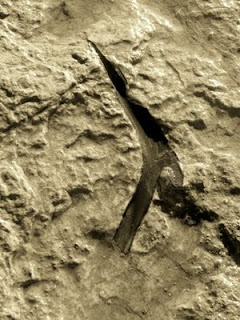
of stones signified something important contained within. The largest held the dilophosaurs that were taken, and which the Navajo were now fighting to get back so they could build their own museum, and an individual that still remained while another protected a single, dark brown claw still buried in the rock.
Reaching the far end of the track Junior turns and asks us if we enjoyed the tour and any ‘donation’ would be appreciated, though most people pay $10. All along I had been waiting for this, having experienced similar but unethical scams in Venice where you are taken to a glassworks and have to pay to be shown the way back to your hotel, so was ready to pay more than the ‘suggested’ price to this fascinating man who gave us a snapshot of an amazing life lived in one of the planets most incredible regions. I heartily recommend this area for a if visit if you find yourself heading to the Grand Canyon or Monument Valley.