Showing posts with label fossil. Show all posts

Saturday, April 9, 2016

Utah Part 2. Red Fleet State Park


Utah is a great place for dinosaur fans. Not only do you get to drive through a town called Dinosaur that literally has streets named after some of the most iconic species found in the region, you also pass through Vernal- a small town whose main street is literally lined with dinosaur advertising signs right out of the long gone America of the 50s.

Vernal is also home to the Utah Field House of Natural History, but we shall talk about that later. The road to the National Dinosaur Monument also passes through the town, as well as the road to the Red Fleet State Park and the field of dinosaur footprints it contains.

It is only a dozen miles from Vernal, and you drive through some very pretty country, so the trip passes quickly. The car park is well signed, and so is the walking path to the footprints - there are even dinosaur prints painted in certain locations to ensure you cannot get lost.


The walk is great- small ravines of weathered rock past real desert plants, desert cactuses and gnarly, ancient desert trees. There is enough geology to poke a stick at, and signs explaining what you are, or are about to see.
Now I should point out in my current research it seems the fossil footprint location has had an upgrade, with more signage to help you work out what you are seeing. I did not have any trouble finding them at the time, though I had been to similar sites in Arizona, so had a fair idea what I was looking for.
Sadly I had just had a great chat with one of the people working at the nearby natural history museum, who mentioned someone had recently attacked the fossils, and some did indeed seem to be damaged. There are still plenty of great prints, but while I was looking around I could see a small part where someone had indeed been naughty. I even found a single small footprint a little way off the formation, broken away from the main layer of rock, and lying where it seemed to have been dropped. I turned the little fossil over and hid it in a spot, then later contacted the museum and told them where it was so they could go out and save it.
I honestly do not know if that was the right thing to have done, but there was every chance someone was going to carry it away, or it was going to be either lost or destroyed- perhaps both- so I think it was a good thing to do and the museum seemed to appreciate it.

The amount of tracks you can see depends on the season. They lie beside the park’s water reservoir, which rises and falls throughout the year. This of course means when there is more water in the lake, there are less fossils to see, and when the water falls, it exposes more of the track ways.
As the footprints are merely impressions in the rock, they are of course the exact same colour as the rock and easily missed. A bit of water and the prints show right up, however, and it’s easy to see long lines of tracks made from a single dinosaur walking along the floodplain that once lay along this part of the state 200 million years ago.

Most of the footprints seem to belong to Dilophosaurus, a large theropod from the Early Jurassic and one of the star critters from Jurassic Park. Remains of the dinosaur have been found across the northern hemisphere, and possibly even in India- meaning they were present on Gondwana as well as Laurasia.
Unusual for a dinosaur species, it would seem Dilophosaurus is known almost equally from footprints as well as fossilised remains, with identical tracks like the ones in Utah being found in Arizona, Sweden, Poland and possibly Massachusetts.
One of these Massachusetts impressions deserves special attention as it seems to show a spot where a Dilophosaurus sat down. There is a clear body print and footprints, and for a while it was thought little grooves around the spot where it had sat were feather impressions. Today it’s believed these were more likely cracks in the drying mud the dinosaur sat in.


Back to Utah. As I said, the Carpark is a good one, with a number of amenities, including toilets, but the important thing to do when you visit is bring water with you. The footprint site is located in a desert, and though the walk is short, during summer it’s going to be hot and if you miss the track, well then, you have just found yourself lost in a desert- not a good thing to do without water.

Monday, November 16, 2015

THE FICK FOSSIL AND HISTORY MUSEUM


 Driving through the Great Plains one of the constant features along the highway are the monster billboards highlighting local features you are approaching (or at times still nowhere near), and one we were desperate to visit was the Prairie Dog Town, whose numerous ads announced the presence of a living 5 legged cow.
Pulling off the highway and into the tiny town of Oakley we could not miss the huge statue on the only high ground for miles. Riding his favourite horse "Brigham" as he rides down a bison is the bronze statue of Buffalo Bill. This is an unusual statue as walking up the crest of the hill where it stands are numerous information displays and even short radio announcements you can listen to about the Buffalo hunter and the history of the region.
One of the smaller museums I was happy to find while exploring the vast grasslands of the US was The Fick Fossil and History Museum, which Wikipedia states: “is a museum that displays large dinosaur fossils from Kansas, many old tools, mineral specimens, and shell and mineral folk art.” Sadly this is not true, or at least was not an accurate description during my visit. While the museum does display fossils of many prehistoric creatures, nowhere do I recall seeing a dinosaur.
The Fink museum is located in the same building as the local Oakley library, and was built after the town was given an unusual donation by Ernest and Vi Fick in 1972 of a number of fossils and artworks - and strangely a number of artworks containing fossils.
During the Late Cretaceous much of central USA lay under the Western Interior Seaway, which created vast beds of chalk that so many of the world’s most famous marine fossils were discovered lying within. Amongst the fish, turtles, sharks and birds have been found long necked plesiosaurs and numerous complete mosasaurs.
Because so many marine fossils are found around the region, the Ficks collected some of the more common fossils and added them to their artwork. Some of the landscape paintings they created contain hundreds of fossils; and often these make up everything, including the trees my favourite by far is the enormous shark made up from thousands of fossil shark teeth.


Also on display are is one of the world’s oldest known mosasaur fossils, along with a 15 foot Xiphactinus Audax specimen that had been prepared by well-known Kansas fossil-hunter, George Sternberg.


 There are some items of interest not to be missed, including the complete paddle from a Plesiosaur that may contain the evidence for why only the paddle was found. Running across the large bones of the reptiles flipper are a number of large grooves, believed to be from the teeth of an attacking mosasaur.
As a local museum, many of the specimens were found and donated by local residents, and the displays often proudly announce who found the item and any story that went along with the fossil and its finder.
The Discover Oakley website points out it is not only fossils that can be seen at the museum either. The display proudly: “houses replicas of Oakley’s first Depot, a sod house, Prather’s Creamery, and Oakley’s General Store. The museum also houses a large, impressive collection of rocks and minerals from the Oakley area and around the world including the remains of ancient tombs!”
...by the way, I never did get to see that 5 legged cow!

Entry is free- as for hours, it is likely bet to contact the museum to find out when it is open as it seems to have limited operational hours during winter. 
the museum can be found at:
700 W 3rd St, Oakley, KS 67748, United States
PH +1 785-671-4839


Wednesday, April 1, 2015

Uffington White Horse - On the Road in the UK, Part Three

 
13 days into our circumnavigation of the UK, having already driven through north England, Scotland, Ireland and Wales, we had every intentions of visiting one of the largest air shows in the world, the Royal International Air Tattoo. Held at the RAF Fairford at Gloucester, unfortunately a week of solid rain had led the organizers to cancel the 2008 show and so our plans changed.
It was hard to be too disappointed, however, as the cancelation gave us a chance to visit one of the most iconic prehistoric sites in the UK.
The famous White Horse at Uffington is situated in the county of Oxfordshire and is the oldest hill figure in Britain.  The horse was thought to have been built during the early Iron Age, or possibly first cut into the ground as far back as 1000BC- placing it in the Bronze Age and an astonishing 3,000 years old. Unlike most other white horses in the UK (which are more recent) paleoanthropologists and archaeologists have found Iron Age coins with depictions of a strikingly similar image in the region, all but confirming its existence at the time.

An examination of the soil at the bottom of one of these lines using Optically Stimulated Luminescence (which measures radiation levels in soil) later confirmed the image had indeed been built in the Late Bronze Age.


To visit the horse we drove up Lambourn Valley Way to the car park. From here there is a path along a gentle slope, which gets a lot steeper as you get closer to the horse. The entire complex is far larger than you’d expect, so wear comfortable, non-slip shoes. 
 
NOTE: Make sure you also close any gate you pass though as the area has a lot of sheep, which are natural lawn mowers I’m assuming. 
 
The horse itself is 114m (374ft) long, giving you an idea how large and steep the hill is; in fact once at the top you get a commanding view of the countryside as far as the eye can see.
You can see so far that in one area I could see a large storm, while on the other side of the hill was fine sunshine.
I was also so high (geographically speaking) I still managed to get a bit of an air show when a RAF Hercules buzzed the hill, possibly flying back from the distant air base. Indeed the hill - which is the highest point in Oxfordshire - rises so steeply from the patchwork landscape below it is regularly used by paragliders to launch into the air.
There is no barrier protecting the horse, which has been the subject of clowns either destroying the image or adding to it (at one point the horse was given a rider to the horror of those charged with its upkeep), so you need to be a little careful, but it’s also amazing to be able to get this close to the real thing.
The hill is a protected site, and used to be ‘scourged’ every 7 years to keep the image crisp and clean. Without this upkeep the horse would quickly fade from view.  This work is done by officials from National Heritage.


The chalk itself has been dated to the Cretaceous, making it around 80 million years old.


Though there had been rain all week, I was lucky enough to head up to the horse in patchy sunshine, and it was a great stroll. The path is well worn, the natural grassland mostly manicured- I assume from the numerous sheep- and the air was alive with butterflies and bees.
Along the path from the carpark there is a view just before the horse of an interesting Pleistocene geographic feature. It is believed the valley running just under the Horse’s head, known as The Manger, was formed during the Ice Age as melted ice water ran away from the hill. This is known as a ‘dry valley’ as there is no evidence of a river or creek that could have formed the depression, indicating it was created during the Ice Age by a glacier or melted ice. The name comes from the legend that it is in this large grassy depression where the White horse feeds at night.
At the far end of the valley are also the ‘Giant Stairs’; a series of step-like structures that were also most likely formed from melted ice water (called avalanche chutes) . There is also a series of large levelled out platforms, possibly formed by prehistoric farmers to create terraced crop beds. Apparently there also use to be a wheel of cheese chasing competition down the side of the Manger, and standing at the top and looking down I realised there are just some things I will not do for dairy products.
Further up the hill is the Bronze/Iron Age fortress called Uffington Castle, likely placed there for its commanding views. Sadly I was totally unaware of its existence when I visited and happily wandered past it. I do not recall anyone heading up towards it at the time, nor any signage along the path pointing it out, so just keep it in mind if you ever get the chance to visit.
Dragon Hill
At the foot of the hill the White Horse sits on is Dragon Hill. This is a natural formation made of the same Cretaceous chalk as the horse, which at some point had its peak levelled off to create a wide, flat platform.
In mythology this small hill is where Saint George confronted and slew the great dragon. Even today there is a large exposed patch of the white chalk the hill is made from, and legend tells us this is where the blood of the dragon spilled, burning the ground and making it forever barren.
The association of both features has led some to suggest the White Horse above is not actually a representation of a horse at all but is in fact the slain dragon- others suggest it might be a fox.
Dragon Hill has also been suggested as the final resting place of Uther Pendragon, linking the feature to the legend of Uther’s son, King Arthur. This hill is a natural structure, so it likely has nothing to do with any sort of burial.
If you are walking to this spot from the White Horse, make sure you take your time as the path down the hill is insanely steep and you don’t want to imitate a rolling cheese; and though there are stairs cut in places, it is still steep. The path also crosses Dragon Hill Road, which cuts between both formations, so keep an eye out for vehicles when moving along the road.
 

Sunday, July 13, 2014

The National Opal Collection


Opal- there is no precious stone in the world that catches the eye the way these stones that Shakespeare called the ‘Queen of Gems’ do.
 On a continent known for its mineral wealth, Australia’s national gemstone it seems is not a mineral at all as it has few of the characteristics true minerals possess (such as a uniform crystalline structure). Instead Opal is considered a mineraloid, and for dinosaur fans it could be argued it’s the gemstone that could represent the Mesozoic.

Opal requires very specific geological conditions to form and Australia produces over 95% of the world's opal because in the Late Cretaceous the middle of the continent sat under a warm, shallow ocean.
The Eromanga Sea lasted for around 80 million years and produced fine sand rich with silica- a strange substance that can be considered a mineral, but also is produced synthetically and biologically. This silica rich water seeped deep underground (helping form the Great Artesian Basin) and filled any void and coated any fossil it encountered. This silica then took several million years to harden and form opal.

This isn’t the only way opal forms, only the most common. Sometimes bacteria slowly dissolved away biological material such as leaves and shells and left behind silica in the exact shape as the original material.
Because the Eromanga Sea covered such a large distance, the opal it would eventually produce is as diverse as the locations where it can be found. In the flat, hot South Australian town of Coober Pedy (where the vast majority of opal is mined) most of these stones are considered ‘light’ opal and the fossils found here are almost all marine. Lightning Ridge in NSW is not only the birthplace of Mr. Crocodile Dundee himself, Paul Hogan, but the most fantastic ‘Black’ opal. Its fossils seem to suggest the region was a forest with large rivers running down to the inland sea. Queensland has not only the most productive dinosaur fossil fields in Australia, but also produces ‘boulder’ opal. Both marine and terrestrial fossils are found in this location, indicating this part of Queensland might have once been a series of islands

In Australia it’s possible to see great examples of all three types, along with a number of fantastic opalised fossils at the National Opal Collection. This has two localities, one in Melbourne (which I visited years ago) and the second in Sydney. Both have free entry and are attached to a large opal showroom where visitors can purchase their own gemstone to take home.
Though not the largest museums in the world, they are well presented with both life-like models of dinosaurs, pterosaurs and the world’s most famous opalised fossil, Steropodon. These are great to see, but in this museum it’s all about the opals, and Sydney’s National Opal Museum has plenty to see.

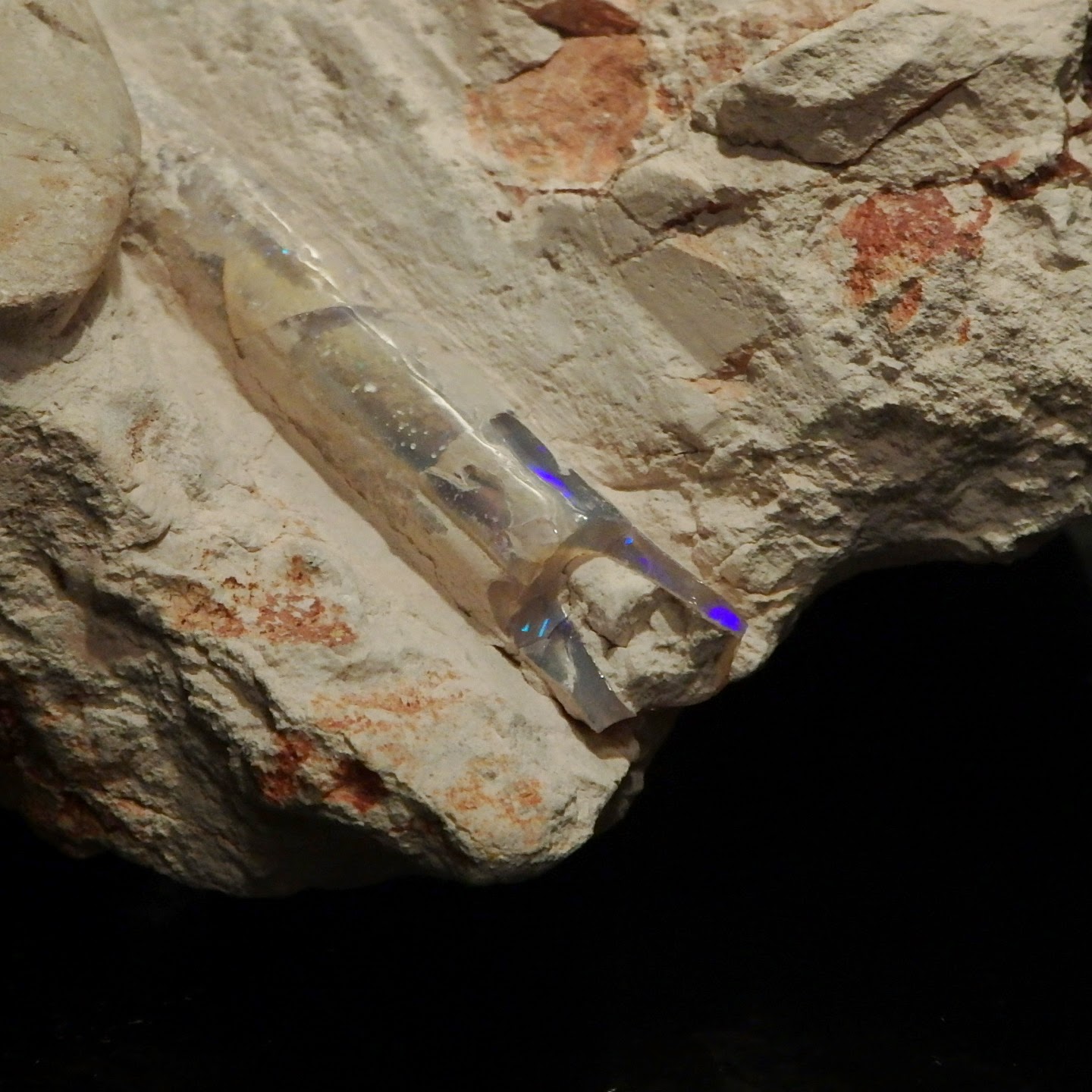
 There are the usual opal shells, a few starfish and the long, tooth-like inner guards from the extinct cephalopods called belemnites. The museum also has a large number of turtle fossils, along with crocodile scales and the teeth of large lungfish, all opalised.

The most famous fossil on display is ‘Nessie’, a near complete juvenile plesiosaur (possibly a pliosaur) found at Andamooka, South Australia, in 1968 and has been placed under Australia’s National Heritage Laws. 50% of Nessie’s fossils have opalised, and in the marine reptiles stomach were discovered gastroliths, belemnite guards and fish bones- many of which had opalised too.
Though far from complete, the museum hosts a large number of opalised dinosaur fossils as well. Amongst the ribs, vertebra and a possible dinosaur claw are a number of large theropod teeth. These were from a medium size carnivore, though due to the nature of the opalisation these fossils do not contain many details to let us work out exactly what sort of theropod they came from.

Though far from the only museum hosting opalised fossils (Bathurst, the National Dinosaur Museum and the South Australian Museum has opals on display), Australia’s National Opal Collection contains a number of great specimens and well worth a look.