The first day of our circumnavigation of the UK led
us through Cambridge, and I was keen to stop by and visit the famous university’s
natural history museum.


Cambridge is a great walking city, with cobbled streets
and lanes packed with spired buildings and wide, green courts lined with ancient
trees. These streets were very busy when we arrived and the reason for this
became evident when we noticed large numbers of people walking around in gowns -
it turns out we were there during graduation. This proved to be good timing for
us as we had the run of the museums.

Dr John Woodward was a late 17th and
early 18th century scientist who, upon his death, bequeathed his
natural history collection and a substantial amount of cash and land to the University
of Cambridge. This led to the Woodwardian Professorship of Geology (still a
valid chair today) and the Woodwardian museum at Cambridge. Today this museum
is part of the larger Sedgwick Museum of Earth Sciences.
This makes Sedgwick one of the world’s oldest
museums, with its origins dating back to 1728.
 Home to around 2 million geological specimens and
fossils, the museum is ‘a major teaching
and research resource in the Department of Earth Sciences.’
Home to around 2 million geological specimens and
fossils, the museum is ‘a major teaching
and research resource in the Department of Earth Sciences.’


The front door is at the end of a rather grand
double staircase, with bison statues on one side and bears on the other. Inside
the display is like stepping back in time- in a good way I assure you. Sure
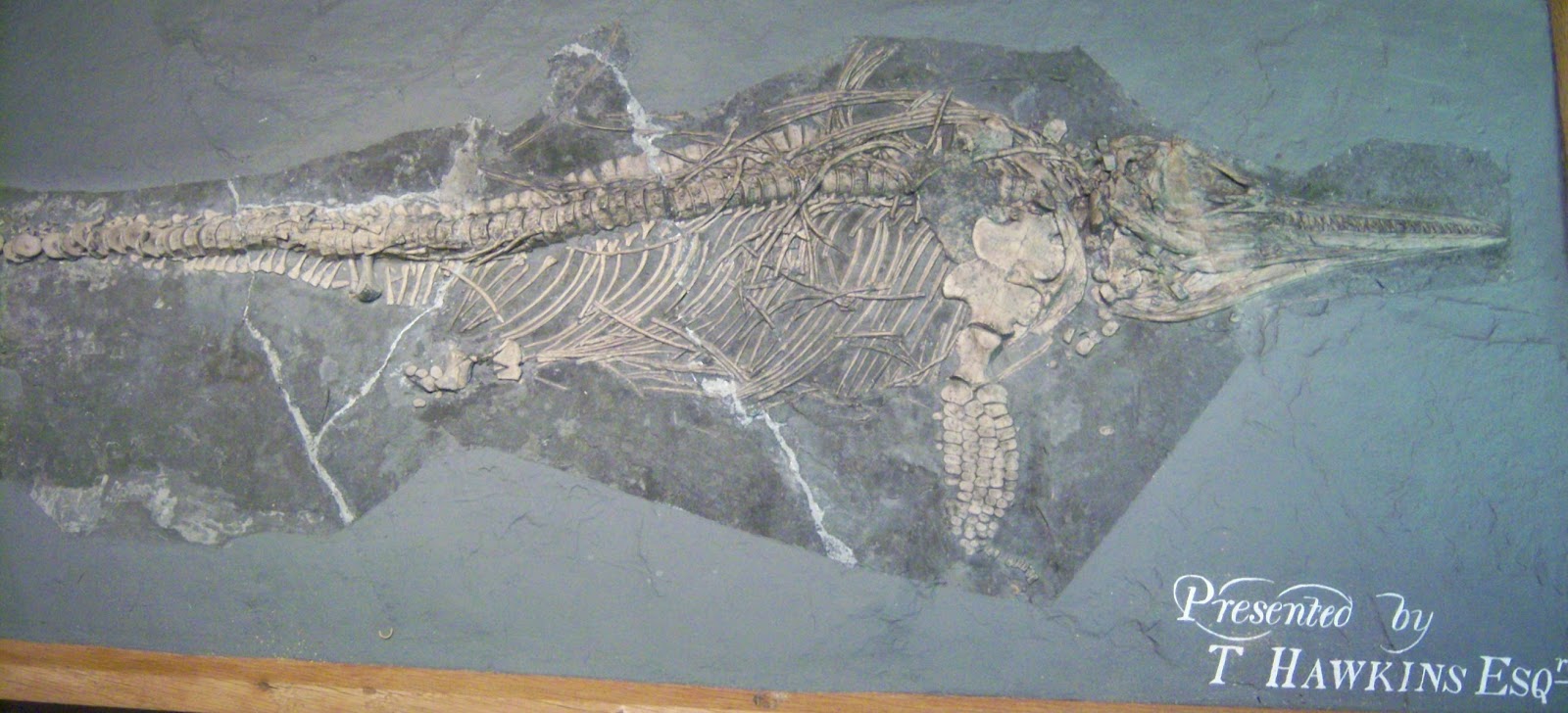
there are modern displays of ichthyosaurs, dinosaurs and ancient mammals, not
to mention a number of modern dinosaur replicas- such as a copy of the skull
from Stan, the T. rex - but these all seem almost secondary to the gems in the
old style display cabinets- and when I say old style, I’m not kidding.


 Charles Darwin was Sedgwick’s most famous student,
and there is a large display in the museum of the fossils the naturalist brought
home from the HMS Beagle voyage.
These tiny treasures were given to the museum after Darwin’s death.
Charles Darwin was Sedgwick’s most famous student,
and there is a large display in the museum of the fossils the naturalist brought
home from the HMS Beagle voyage.
These tiny treasures were given to the museum after Darwin’s death.


The display is split into two wings, with the
Mesozoic fossils on one side and older Palaeozoic fossils on the other.
Standing between the two is a life size bronze statue of Adam Sedgwick, one of
the fathers of modern geology and the man who first recognised and proposed the
Cambrian and Devonian Periods. Highlighting this, the statue holds a geological
hammer in one hand, while in the other outstretched hand he holds that
universal symbol for fossils everywhere, a trilobite.
 Charles Darwin was Sedgwick’s most famous student,
and there is a large display in the museum of the fossils the naturalist brought
home from the HMS Beagle voyage.
These tiny treasures were given to the museum after Darwin’s death.
Charles Darwin was Sedgwick’s most famous student,
and there is a large display in the museum of the fossils the naturalist brought
home from the HMS Beagle voyage.
These tiny treasures were given to the museum after Darwin’s death.
This and many other displays are amongst the great
enjoyment of this museum to a paleo-nerd. Not only have many items kept their
original labels, some now centuries old, but just to read some of the names of
those who collected them is a thrill.


 The museum is really like a greatest hits album from
the golden age of palaeontology. Row after row, cabinet after cabinet are brimming
with fossils from the quarries of Europe. There are German pterosaurs; along
with ichthyosaurus and pliosaurs from Whitby, Devonian fish from Canada,
ancient stromatolites from Australia and tusked dicynodonts from South Africa- prehistoric
remnants from the once global spanning English empire.
The museum is really like a greatest hits album from
the golden age of palaeontology. Row after row, cabinet after cabinet are brimming
with fossils from the quarries of Europe. There are German pterosaurs; along
with ichthyosaurus and pliosaurs from Whitby, Devonian fish from Canada,
ancient stromatolites from Australia and tusked dicynodonts from South Africa- prehistoric
remnants from the once global spanning English empire.


It is also worthwhile taking a walk outside all around the building as there are a number of gargoyles and stone depictions of prehistoric life everywhere.


It’s all well and good to read about the great men
and women of palaeontology, but to actually see specimens collected by Agassiz,
Huxley, Cope, Leidy, Buckland, and the dame of English palaeontology, Mary Anning.

Though there are fossils from all over the world,
including some rare Burgess Shale specimens, most of the fossils on display are
from regions around the UK.

The most iconic of these early dinosaurs was Iguanodon,
one of the first found and described, explaining why there is a stone carving
of one standing guard over the coat of arms above the front door (the second
animal I judge to be a giant sloth). There is also a complete skeleton towering
over the front door to the museum.
The Museum’s website takes up the story of its
skeleton: ‘we have a letter sent on 26 October
1825 by Dr Gideon Mantell (the discoverer and describer of Iguanodon) to
Professor Adam Sedgwick. The letter came with a parcel of specimens, including
... " casts of the best teeth of the Iguanodon in my collection; and of a
horn (which you well doubtless remember) which the French [experts] declare is
the bony base of a horn of a saurian animal – of course I shall claim it for
the Iguanodon." Some of these original specimens are exhibited nearby.’

The museums specimen is the cast of Iguanodon bernissartensis,
one of the complete individuals found by Louis Dollo, who: ‘described these dinosaur remains in the
1880s and kindly offered to Cambridge (through King Leopold II) a cast of one
of the best Bernissart Iguanodon skeletons. The rearing pose of the animal
conforms to Dollo’s original conception of the animal, but we now understand
(through the work of a former Director of the Sedgwick Museum) that it would
have normally walked with a more horizontal pose.’
There are not that many dinosaur skeletons left in
the original kangaroo-pose, so for that alone the Iguanodon is worth a look.

The other species to start the world wide craze for dinosaurs in the 1820's was William Buckland's Megalosaurus and the museum proudly displays a skull fragment of M. bucklandi, a dinosaur that has been recently renamed Duriavenator bucklandi.


It is also worthwhile taking a walk outside all around the building as there are a number of gargoyles and stone depictions of prehistoric life everywhere.

The Sedgwick Museum of Earth Sciences can be found AT University of Cambridge, Downing Street Cambridge. Admission is free, and it is open from 10am to 1pm, then 2pm to 5pm Monday to Friday; and 10am - 4pm on Saturdays. The museum is closed on Sundays and some public holidays so check the museums website for these on:
www.sedgwickmuseum.org


