Showing posts with label Megalosaurus. Show all posts

Sunday, June 12, 2016

The Sedgwick museum - Cambridge pt1.

The first day of our circumnavigation of the UK led us through Cambridge, and I was keen to stop by and visit the famous university’s natural history museum.


Cambridge is a great walking city, with cobbled streets and lanes packed with spired buildings and wide, green courts lined with ancient trees. These streets were very busy when we arrived and the reason for this became evident when we noticed large numbers of people walking around in gowns - it turns out we were there during graduation. This proved to be good timing for us as we had the run of the museums.

Dr John Woodward was a late 17th and early 18th century scientist who, upon his death, bequeathed his natural history collection and a substantial amount of cash and land to the University of Cambridge. This led to the Woodwardian Professorship of Geology (still a valid chair today) and the Woodwardian museum at Cambridge. Today this museum is part of the larger Sedgwick Museum of Earth Sciences.
This makes Sedgwick one of the world’s oldest museums, with its origins dating back to 1728.
Home to around 2 million geological specimens and fossils, the museum is ‘a major teaching and research resource in the Department of Earth Sciences.


The front door is at the end of a rather grand double staircase, with bison statues on one side and bears on the other. Inside the display is like stepping back in time- in a good way I assure you. Sure there are modern displays of ichthyosaurs, dinosaurs and ancient mammals, not to mention a number of modern dinosaur replicas- such as a copy of the skull from Stan, the T. rex - but these all seem almost secondary to the gems in the old style display cabinets- and when I say old style, I’m not kidding. 

The display is split into two wings, with the Mesozoic fossils on one side and older Palaeozoic fossils on the other. Standing between the two is a life size bronze statue of Adam Sedgwick, one of the fathers of modern geology and the man who first recognised and proposed the Cambrian and Devonian Periods. Highlighting this, the statue holds a geological hammer in one hand, while in the other outstretched hand he holds that universal symbol for fossils everywhere, a trilobite.
Charles Darwin was Sedgwick’s most famous student, and there is a large display in the museum of the fossils the naturalist brought home from the HMS Beagle voyage. These tiny treasures were given to the museum after Darwin’s death. 
This and many other displays are amongst the great enjoyment of this museum to a paleo-nerd. Not only have many items kept their original labels, some now centuries old, but just to read some of the names of those who collected them is a thrill.

It’s all well and good to read about the great men and women of palaeontology, but to actually see specimens collected by Agassiz, Huxley, Cope, Leidy, Buckland, and the dame of English palaeontology, Mary Anning.


Though there are fossils from all over the world, including some rare Burgess Shale specimens, most of the fossils on display are from regions around the UK.
The most iconic of these early dinosaurs was Iguanodon, one of the first found and described, explaining why there is a stone carving of one standing guard over the coat of arms above the front door (the second animal I judge to be a giant sloth). There is also a complete skeleton towering over the front door to the museum.
The Museum’s website takes up the story of its skeleton: ‘we have a letter sent on 26 October 1825 by Dr Gideon Mantell (the discoverer and describer of Iguanodon) to Professor Adam Sedgwick. The letter came with a parcel of specimens, including ... " casts of the best teeth of the Iguanodon in my collection; and of a horn (which you well doubtless remember) which the French [experts] declare is the bony base of a horn of a saurian animal – of course I shall claim it for the Iguanodon." Some of these original specimens are exhibited nearby.’
The museums specimen is the cast of Iguanodon bernissartensis, one of the complete individuals found by Louis Dollo, who: ‘described these dinosaur remains in the 1880s and kindly offered to Cambridge (through King Leopold II) a cast of one of the best Bernissart Iguanodon skeletons. The rearing pose of the animal conforms to Dollo’s original conception of the animal, but we now understand (through the work of a former Director of the Sedgwick Museum) that it would have normally walked with a more horizontal pose.’
There are not that many dinosaur skeletons left in the original kangaroo-pose, so for that alone the Iguanodon is worth a look.
The other species to start the world wide craze for dinosaurs in the 1820's was William Buckland's Megalosaurus and the museum proudly displays a skull fragment of M. bucklandi, a dinosaur that has been recently renamed Duriavenator bucklandi
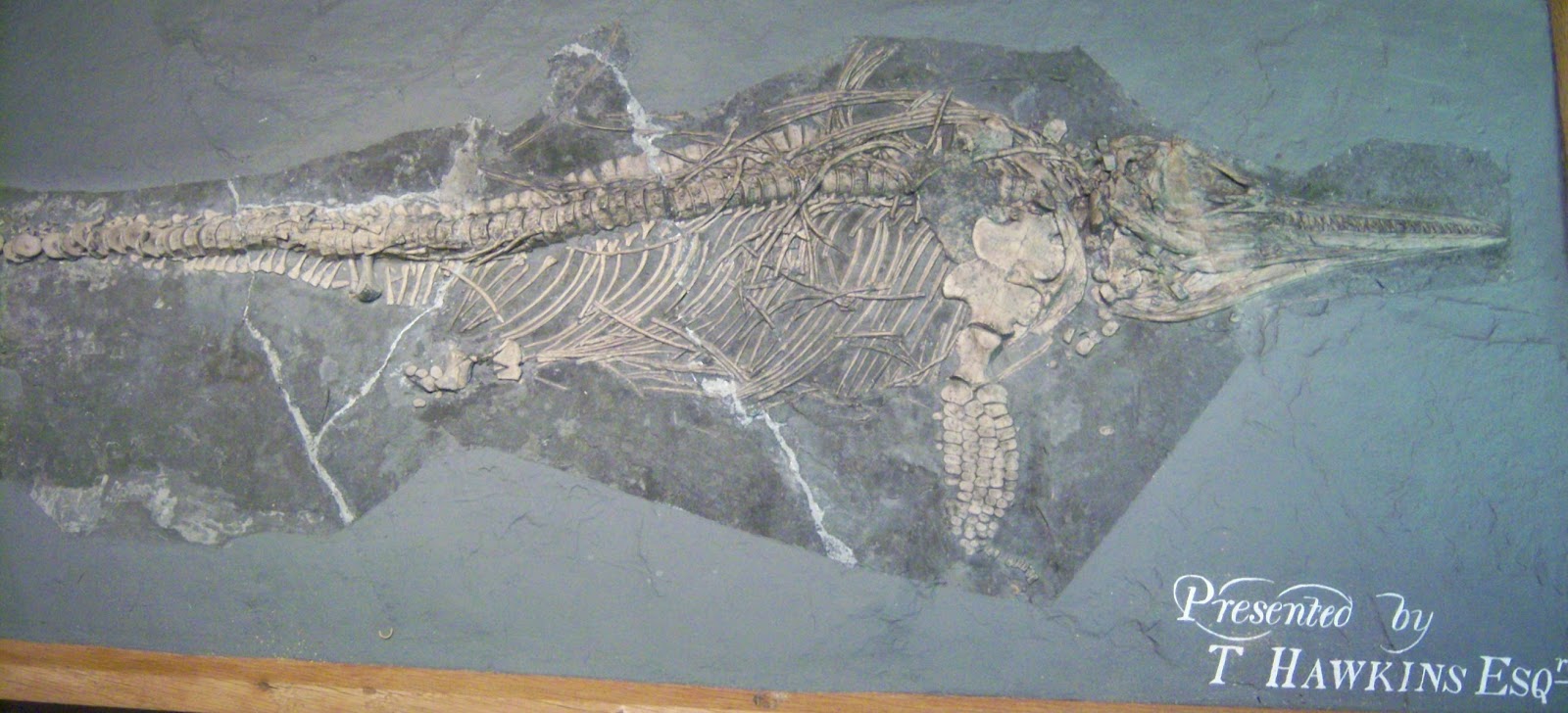
The museum is really like a greatest hits album from the golden age of palaeontology. Row after row, cabinet after cabinet are brimming with fossils from the quarries of Europe. There are German pterosaurs; along with ichthyosaurus and pliosaurs from Whitby, Devonian fish from Canada, ancient stromatolites from Australia and tusked dicynodonts from South Africa- prehistoric remnants from the once global spanning English empire.


It is also worthwhile taking a walk outside all around the building as there are a number of gargoyles and stone depictions of prehistoric life everywhere.


The Sedgwick Museum of Earth Sciences can be found AT University of Cambridge, Downing Street Cambridge. Admission is free, and it is open from 10am to 1pm, then 2pm to 5pm Monday to Friday; and 10am - 4pm on Saturdays. The museum is closed on Sundays and some public holidays so check the museums website for these on:
www.sedgwickmuseum.org

Sunday, March 10, 2013

Oxford University Museum of Natural History


The gathered crowd of learned gentlemen murmured amongst themselves about the argument that had erupted on the auditorium floor. On one side stood Samuel Wilberforce, the Bishop of Oxford, one of England’s finest public speakers and a man who had recently barraged his parishioners with a tirade against Charles Darwin and his recently published book ‘On the Origin of Species’. About Wilberforce stood many of those whose opinions mirrored his own.
Opposite them were the less numerous but equally vocal defenders of Darwin, including the man who would one day be dubbed Darwin’s Bulldog for his tenacious advocacy of the theory of evolution, Thomas Huxley.
Wilberforce had arrived at the meeting of the British Association to bring the lords wrath into the debate and stood before the gathered crowd, his booming voice clear as a bell as he scorned Darwin’s idea. Though his argument contained a decidedly religious stance, it also contained enough scientific information to prove he had been coached by one of Darwin’s more learned evolutionary adversaries, Sir Richard Owen.
The ‘Man of God’ could certainly talk and soon had many of those gathered in the auditorium eating out of his oratory hand. Like any professional entertainer, Wilberforce built a report with the audience with charm and wit, setting them up for the peak of his speech. After reminding everyone of the beauty of the Lords plan for the world and how dark the universe would seem without a guiding hand, he lordly turned on the science and pointed out how there was no evidence to support Darwin’s grand idea and that most scientists actually disagreed with the theory.
 Wilberforce ended with a grand flourish, gesturing towards his opponent and asking if it was on Huxley’s grandmother or his grandfather’s side that he considered himself descended from a monkey?
The crowd erupted in laughter at the gibe and, as Wilberforce returned to his seat in good humour and gave the floor to Huxley, only those paying close attention noticed the naturalist was also smiling.
Once the room had quieted down Huxley, a peerless orator himself, nailed the Bishop to his chair with a steely glare and replied….
‘I would not be ashamed of having a monkey for an ancestor, but I would be ashamed to be connected to a man who uses his great gifts to obscure the truth!’

The story above is my dramatization of the famous evolution debate that occurred in the newly built Oxford University in the 1860’s, a building that now houses the collections of some of the world’s first palaeontologists. The Neo-Gothic building that held this debate is now a Grade-1 listed historical building in England and today houses the Oxford University’s Museum of Natural History.
A competition had been held for the design of the building with a stipulation iron and glass must be incorporated into the building. It was one of the builders who pointed out it would be cheaper if Wrought iron was used instead of the stronger, more expensive cast iron. The softer Wrought iron was used to help create the intricate details on many of the museums features, while cast iron remained wherever strong support was needed to hold up that amazing, cathedral-like glass roof.
    It really is one of the world’s best looking museums and once you visit you understand why it’s being protected. The problem with visiting, however, is you have to visit Oxford and believe me this is easier said then done. The town is a rabbit warren of tiny little streets and no, and I cannot repeat this strongly enough, NO parking. Either catch a bus after you have parked outside the city or be ready to drive around for a few hours until you find one of the very few street car parks (and I’ve just read they’re planning to cut down even more traffic in an effort to ‘pedestrianise’ the city, so things are likely to get even worse in the near future).
In truth this isn’t as bad as it sounds since, while you’re driving around looking for somewhere to park, you really do get a great look at the city, though if you have limited time it can be frustrating.

Once you’ve parked and walked about the same distance as you would have if you’d walked to Oxford, you’ll easily find the museum. It looks like an old church on the outside and is one of the few buildings with a large lawn in front- containing dinosaur footprints running across it (from a Megalosaurus or possibly Cetios), which should help. As great as the building is on the outside, it’s inside that the museum that really blows you away.

 Harking from a time gone by, the majority of the museum’s exhibits are contained within the cathedral-like main court of the building. This all sits under an elaborate roof of Victorian ironwork and glass, supported by numerous intricately decorated columns in a series of high arches that create three adjacent aisles. Standing in the middle of all this is one of the best Tyrannosaurs I’ve ever seen, though whether it’s the ferocious pose or the fantastic backdrop that makes it so great still eludes me. One of the best images in the museum is, when you get to the right angle, seeing this T-rex in comparison to the tallest animals in the world today, the skeleton of a giraffe. It makes you realise there just is no comparison.
Each aisle houses a numbers of displays, like a row of mammal skeletons or dinosaur fossils, and (while I was there) a large number of props from the ‘Walking with Dinosaurs’ series. There is also an Iguanodon, standing in the old kangaroo-style pose, along with row upon row of modern animal skeletons.
Along the walls, amongst the numerous statues of historical men of science, are glass displays and Victorian cabinets containing every type of fossils you can think of along with a living counterpart if available. Even though the museum is mostly contained in one large room, the display really does have everything you’d want from a modern natural history exhibit.

I’m hard pressed to think of any major prehistoric group that didn’t have some sort of presence at Oxford, I mean there was even a display with a number of Gorgonopsians, and I mean a number, not just the solitary skull most museums display. I should point out the entire prehistoric mammal collection is amazing, including a Cave Hyena which, for sometime, was an intricate part of early palaeontology. Kirkdale Cave is where many early fossils were unearthed in the UK, and these helped scientists at the time understand the very land about them had changed and began challenging the idea the bones found in the earth had been deposited by Noah’s flood. It was clear many of these fossils had come from an ancient predators den.
The main focus of Oxford is what it’s famous for, dinosaurs like Megalosaurus, along with the history of the fossils and the men who found them. It was William Buckland’s Megalosaurus (unearthed at nearby Stonesfield) that began the whole dinosaur obsession, a craze that seems to be running as strong today as it did back then. The museum also holds the ‘Red Lady of Paviland’, a Palaeolithic human skeleton that had been buried in red ochre and the first paleo-human fossil found anywhere in the world. Buckland had found the near complete remains in 1823 during a dig in Wales, and as you can tell by the name, he believed he’d found the remains of a woman.
The museum has many of the early fossils from Megalosaurus on display. It was also home to the first ‘fossil’ ever described, the lower part of a theropod limb bone. At the time of its discovery dinosaurs simply weren’t known, so thanks to the size and shape of this fossil, the great ‘terrible-lizards’ received their first ever scientific name, Scrotum humanum, from Richard Brookes in 1763. Nearly a century earlier Oxford’s Robert Plot had recognised the fossil as the remains from a large thigh bone- though he believed it had come from one of the giants mentioned in the bible. There are some who believe the name Scrotum humanum is still valid and should replace ‘Dinosaur’ as the groups name…though how strenuously they believe this I will leave up to you.
One of my favourite exhibits is a large glass cabinet containing a Moa Skeleton. This is the same fossil that sir Richard Owen was famously photographed standing next to all those years ago, and really brought home to me just exactly where it was I was standing. About you are fossils and specimens collected by some of the most famous figures in Natural History. Amongst the William Buckland fossils are specimens collected by Mary Anning, Elizabeth Philpot, Alfred Russel Wallace, Thomas Bell, William Burchell, and Charles Darwin. Where in the world would you see such a collection in one spot?
Another display the museum’s famous for is its Dodo. The most complete remains of a dodo are held here (a mummified foot and head)- though the Oxford collection once held the only stuffed and mounted Dodo known, that is until some moronic museum curator in the mid 18th century felt its was getting a little too ratty and ordered it thrown on the fire. This display stimulated Charles Dodgson, who lived near the museum as a child and spent many long days wandering its galleries being inspired by the bizarre and freakish creatures it contained. You may know Dodgson by his pen name, Lewis Carroll, the man who’d famously place the museum’s Dodo (who many authorities claimed was representing Carroll himself) in his book on the adventures of a little girl called Alice.
All in all the Oxford Natural History Museum is a must see if you’re anywhere near the area (it’s an hour or more drive out of London), if for nothing more than to see that fantastic building…and the Moa…and the Megalosaurus…and the gorgonopsids…and the Liopleurodon...and...


PLEASE NOTE: That window above the museum requires a lot of work and during 2013 the museum will be closed. Though disappointing, those working at the museum have done their best to temper this inconvenience by offering special behind-the-scene tours, giving visitors a rare opportunity to sneak-a-peak behind the looking glass (see what I did there, snuck in an Alice reference, I’m tricky that way).
Contact the Oxford University Museum of Natural History for more information on these tours.

The Museum is also documenting the repairs on a blog, which makes interesting reading to anyone who’s ever wanted to know what goes on at a museum when the doors are closed.

Lastly, anyone who follows my Facebook galleries or has ever received an email from me will know I am the self-proclaimed World Champion Aardvark Wrangler. Well the long hard journey to my world title began at the Oxford University Museum of Natural History


Thursday, August 25, 2011

Crystal Palace

If paleo-geeks have a Mecca, surely it must be the old gardens of Crystal Palace in London. I’d been to the city before and completely missed out on visiting the concrete dinosaurs, designed and built by Benjamin Waterhouse Hawkins in 1852. These were the first life-sized dinosaurs the world had ever seen and helped triggered the first real dinosaur craze.
As I was about to fly home the next day, I was determined not to miss them a second time!
Driving back into the capital from the Isle of Wight, it took a few hours to find Crystal palace, but eventually find it we did. Ever since I was a kid I’d wanted to see these dinosaurs. I cannot think of a single dinosaur book I’ve ever read that didn’t have an image of one of those iconic monsters like the snarling, rhino-like Megalosaurus creeping up on the lounging, arm outstretched Iguanodon.
Hopping out of the car there was only one word for how I felt….giddy.
My girlfriend Jo walked patiently up the hill to the gardens with me and listened patiently as I babbled on and on about what we were about to see and why it was so important. I was in fact so busy talking to her about the display that I almost walked into the very closed and very chained gate with a very large sign on it announcing the Crystal Park Garden would be closed for this day- and this day only.
I think my girlfriend could tell by the ashen colour my face had turned I was more than a little unhappy. Solemnly, we turned and walked away… well I turned, she’d already taken several steps away, perhaps distancing herself from the upcoming explosion of expletives she was certain was about to erupt and possibly get me arrested for public obscenity.
Half way back to the car, dragging my feet like some child who wasn’t allowed to ride the roller coaster, I turned and simply said…‘Not a chance!’
Running around the fence enclosing the park, I eventually found a gardener and told him I worked at a Dinosaur Museum, had been keen to see the gardens my whole life and was flying home the next day, perhaps for good, so there was no way I could come back. The guy said he couldn’t help me but if I went back to the chained side gate, he’d see what he could do.
10 minutes later a Crystal Palace security guard, along with his ferocious guard dog, opened the gate and let us both in, telling us to meet him back at the entrance in about 40 minutes so he could let us out again.
Champions!
Jo and I wandered around the garden and it occurred to me very few people have likely ever had the run of the place by themselves the way we did that day.
What a joy. Crunching our way down the gravel dirt paths on a warm sunny day with the flowers blooming, catching the well sculpted statues of prehistoric creatures emerging out of the foliage, with no screaming parents and bored kids to ruin it for us….it was bliss.
Originally the man-made lake all the figures surround was tidal and the lowering and rising water levels would revel and hide the animals at various time of the day. Todays the ‘lake’ is just a really large pond with a series of small islands that contain most of the exhibits, and as the science of palaeontology grew, the highly inaccurate dinosaur models became more and more ridiculed and the park slowly fell into decline. This process wasn’t helped when the glass monolith of Crystal Palace itself burnt down in 1936.
In the 1950’s the models were cut out of the gardens plant life that had overgrown them, cleaned up, repaired and put back on display, though not in their original positions. This process hadn’t been the best (on one model they’d used plasticine for repairs) and the garden soon started to fall apart again.
In 2002 a complete restoration of the sight was finished with many of the prehistoric (looking) plants that had originally been planted alongside the models replaced, while many of the missing or destroyed figures were substituted with new ones. London had finally woken up to what treasures these models were and they were soon historically listed, protecting them for future generations.
I have to say the workers have done a fine job as the garden is fantastic, full of nooks and crannies where you can spot some prehistoric beastie hiding behind an archaic monkey puzzle tree or antediluvian fern. The display is so well planned that often the animals are visible from numerous locations even though they seem to be completely surrounded by vegetation.
To begin with, as you walk down the path you cross a family of Megalocerous, including a huge stag with antlers that had originally been the real fossils until someone broke in and stole them years ago.
Next, feeding under some trees or beside a creek are herds of Anoplotherium (which look a little like camels even though they were probably more hippo-like) and Palaeotherium (tapir-looking critters). Its many of these smaller figures that had been missing for many years before the 2002 restoration.
Further along you catch a glimpse of the monstrous Megatherium reaching into a tree to feed. This model is often seen throughout the park due to its large size and the fact that there are few trees surrounding it.
As you turn the next corner, you catch a brief glimpse of a wall of scaly skin, which soon blossoms into the complete Megalosaurus. Easily the most inaccurate of all the parks animals, I have to say I didn’t care one bit as this massive creature just looks terrific on its grassy hill. Looking like a cross between a crocodile, a bear and an elephant, the statue is enormous and stands magesticly across the pond.
The path cuts down along the ‘lake’ and you get your first look at what the Megalosaurus is stalking, the equally scaled Iguanodon and Hylaeosaurus that had, up until now, been hidden behind the bend in the creek and a number of strategically placed trees. All three dinosaurs are just so much bigger than any image credits them and I was happy to stand there all day and take them in. Unfortunately we were on a tight schedule and, with a deep, contented sigh we were soon back on the path.
Next the lake opens up and here is where you find the numerous aquatic creatures like ichthyosaurs, plesiosaurs, mosasaurs, labyrinthodonts, dicynodonts, teleosaurs and numerous pterodactyls.
Far too soon our time was up and we made our way back to the gate where the security guard was waiting. He took one look at my huge grin and asked ‘enjoy yourself did you?’
Yes…yes I did!