The Royal
Ontario Museum (ROM) was the main reason I wanted to visit eastern Canada, and
I had intended to drop in on Friday afternoon when it would be reasonably quiet.
Instead I ended up going Saturday morning. Unfortunately this particular
weekend Toronto was hosting its Santa Parade, one of the largest Christmas
parades in the world, so you can imagine how large the crowds were during my visit.
It also didn’t help that the museum was displaying the Dead Sea Scrolls as well
at the time.

Always keen to
try the public transport of a city I caught the Toronto subway system, which I
have to say is easy to use. Working out how to catch a train or bus can sometimes
be a pain in a foreign country as you’ll usually find yourself staring at some
automated kiosk that requires a bachelor’s degree in astrophysics with a minor
in international diplomacy to figure out how to obtain a single daily pass
ticket. Toronto has kept it easy for the infrequent traveller as, just before
the subway turnstile there’s a little ‘bubble-gum machine’ that takes change
(something you always end up accruing and have trouble getting rid of in a foreign
country) and spits out tokens. The added bonus is you get to use a subway
token- how ‘quaint’ is that?

The ROM has its
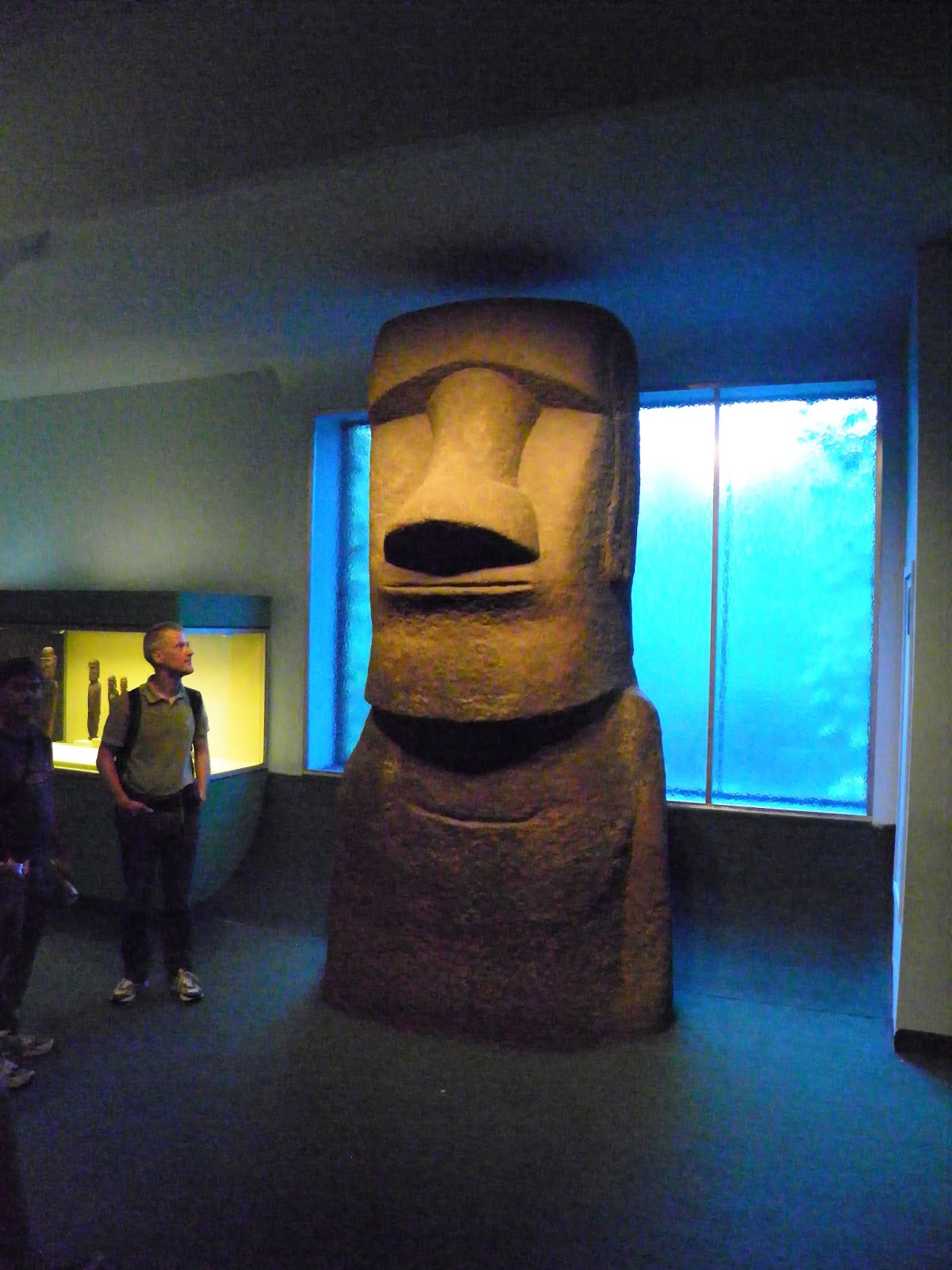
own station on the network and oh what a station it is. Much like the American
Natural History Museum in New York, the platform has been ‘themed’, with all of
the columns holding up the tunnel roof turned into Mayan, Egyptian and Native
American totems and statues.

The museum
itself is a little odd as the older building has recently had a bizarre
extension added to expand the original floor space. Called the Michael Lee-Chin
Crystal, the building now looks like it has one of those old Rubik’s cube
snakes bundled up in the middle of it. This extension is all odd angles and
weird protrusions jutting out in the strangest places and I don’t mind it per
say, but it must be a nightmare to work in as you’d be in constant fear of
smacking your head or shin if your mind wanders off for even a second.

I wasn’t all that interested in the Dead Sea
Scrolls but did have a quick look. As you can imagine there wasn’t a lot to see
as the light levels have to be low to save the ancient parchment, and each
little display was behind some very thick safety glass and surrounded by about
a thousand onlookers. This was definitely not a display to see with a large
crowd. What I did find fascinating was that the museum rotated the scrolls on
display every few weeks, I guess ensuring those Dead Sea Scroll groupies out
there get a chance to see their favourite proverb or ancient Hebrew shopping
list at some point.
Because the ROM
is basically now a building inside another building it can get a little
confusing, so my advice is make sure you grab a map (it has 6 pages, so that alone
should tell you things can get a little confusing inside), and to quote one of
my favourite horror movies, ‘stay on the path’.
Things are set
up that you have to go through some galleries to get to others so there isn’t
any sort of central corridor that I could see. This means make sure you’ve got plenty
of time as I don’t think this is a museum where you can skip in, see the
dinosaurs, and skip out again.
First you’d have
to find them, and this actually took me a few goes as the prehistoric gallery is
through a weird little corridor that, at the time, held a kiddies colouring in
station and a small room full of bird display cases. If I didn’t have the map I
doubt I’d have ever investigated the area beyond this point and may have missed
the dinosaurs all together.
So…through the
room, around the Australian bird display, turn the corner, down the ramp and
you’re now in the first of three prehistoric galleries containing the ROM’s
mammal and Cretaceous displays.
Here you’ll see
some museum staples like an Irish elk
(which I think every museum I’ve visited in the last 3 years has had) as well
as a Mastodon, Giant Sloth, Short Face Bear
and Phorusrhacos.
Each Cenozoic
era seems to be represented by a little island-of-a-display that you can walk
around and view from all four sides. With the largest animals in the middle and
smaller species on the outside, this method allows for more specimens to be shown
then you’d get with just a flat display along a wall. The negative is it makes
the actually viewing of each animal hard as there’s almost always going to be
something in the way of what you’re looking at.
For the general public this
isn’t such a big deal, but for paleo-fans, well it’s impossible to get that isolated
photo of an animal without something else’s hoof, horn or tail getting in the
way. I found myself working pretty hard to get any sort of descent photo of
individual animals, and any group photo quickly merged into a jumble of brown
bones and glass reflections.
As for the dinosaur
displays in the James and Louise Temerty Galleries, well this may sound weird
but I found myself feeling a little sorry for the museum here.
They had a grand
T-rex, a charging bull-like Chasmosaurus, a few ceratopsian
skulls and a Protoceratops, but I found myself wanting something new. I
mean if you go to any natural history museum in the world you’re going to
see most of these species. For all the richness of the Canadian dinosaur fields
they’ve unfortunately exported so many of their iconic dinosaurs to the world that
most native species have now become a little old hat. This feeling certainly isn’t
helped by the fact that there doesn’t seem to be a lot of patriotism involved
with the display either. I never really found myself looking at anything that
was displayed as ‘local’; the fossils were just displayed and you were left to
work it out for yourself… but I’ll talk more about this later.

My growing disappointment wasn’t helped by two
things. The first was that, as I’d been so focused on looking and photographing
the animal displays I never really gave the blank Rubik’s wall behind me a
close look. All those angles and protruding triangle walls meant I’d missed the
tiny, almost hidden corridor from the Cretaceous display into the Jurassic, and
I honestly almost walked away at that point shaking my head thinking ‘is that’s
it?’
As it turns out
it wasn’t.
The Jurassic
room through that little cubby-hole (and across a weird walkway) is stuffed
with dinosaurs, including a 27m Barosaurus, Allosaurus, Stegosaurus,
numerous hadrosaurs, ichthyosaurs, an Albertosaurus, one huge Acheron
stuck hanging in mid-air in one corner, and one of those new oviraptorids
called Chirostenotes.
I know, I know,
much like Jurassic Park, many of the species I just mentioned were in fact Cretaceous.
Due to the way the display is currently set up
I think its organisers have at some stage made a really big boo-boo and are
currently trying to figure out how to fix it. To me the second gallery was
supposed to hold all the dinosaurs, while the first was supposed to be just
mammals, but when they reorganised the museum they realised they couldn’t fit
all those dinosaurs in the one room so they were forced to compromise. Again,
no real proof of this, its just that’s what it feels like and could explain the
jumbled way the dinosaurs are displayed.

Further evidence
of this is that this new gallery is huge, yet for the most bizarre reason the
exhibition’s planners have decided the best place to put their dinosaurs is
next to or behind the roof’s support columns. There’s ample free floor space,
yet everywhere you look a column seems to get in the way, and the reason I found
this so frustrating is that there just isn’t that many columns in the room to
begin with. Surely the fossils could have been arranged in a way that gives you
an uncluttered look at them?

On the far side
of the Jurassic display is the Triassic gallery; well that’s just a white
walled corridor with bare floorboards next to the toilets. There’s very little
colour throughout the three prehistoric galleries to begin with and, with so
much to show, that’s kind of understandable. Yet in this little corner where there
isn’t that much on display you’d think the ROM could really have designed a
display full of colour and life. Instead it’s a featureless alcove that hardly
anybody enters unless they’re dragging a waddling child by the hand that’s desperate
for a pee.

Having done a
little research, later I discovered the ROM’s prehistoric galleries used to be full
of murals, placing many of the skeletons in more life-like settings. They
looked fantastic in the few pictures I’ve managed to find, and this goes back
to one of my earlier points. This type of display really allows you to tell a
story, not only of the animal but where they came from. By placing them in an
environment you get to talk about that environment and can wave a little
patriotic flag at the same time (i.e. this is what Canada used to look like).

I’m not sure what it is, but many museums seem
to be moving away from this more realistic style of display into the more open,
window filled galleries you can see at the ROM and AMNH, and I personally think
it’s a mistake. Cold displays of naked skeletons that become mashed together
with whatever other fossils are nearby is certainly not an attractive way to
look at something that should be instilling the spectator with jaw-dropping
awesomeness. There’s little or no context with an open display like the ROM’s…
and as for this need for modern curators to have natural history displays in
rooms full of windows…STOP IT!

With the sun beating through glass (that’s all
too often dirty on the outside), the display becomes little more than washed-out
black and white skeletons in a room that’s stinking hot during summer and freezing
cold during winter. In the ROM, thanks to all those angled windows, there
literally wasn’t a single display case that didn’t have a dirty big, sun-filled
window reflected in it…and due to the angles of all those weird windows this
isn’t a problem that will go away as the sun moves throughout the day.
Brick up those
windows, splash some paint on those walls and let’s get back to the way we used
to present our dinosaurs shall we?
As for the rest
of the ROM, well it seems to be a cross between a natural history museum and
the New York MET. The remaining galleries were mostly human cultural displays
from around the world.
There’s a great ancient Egypt display and a nice little
room of Art Deco objects (a favourite of mine). There’s also a large collection
of ancient Asian artwork (mostly from China and Japan) that was fantastic.
I may be a little unfair here but the ROM also has potentially
the worst museum gift shop I’ve been to in my life. I mean, there wasn’t a
single dinosaur book for anyone with a reading level past a kindergartener (I
can only hope I perhaps missed another museum store in the kaleidoscope
building).
Also keep an eye
out for a number of other fossils hidden throughout the building. Soaring high
above through one roof space is a skeleton of Quetzalcoatlus, while one wall in the main entry hall had a large hadrosaur.
There may be others, so watch out for them.
Still, despite
my misgivings about the building, the ROM has one of palaeontology’s largest exhibits
of prehistoric creatures…if only they were given a little bit of character it
would easily rank as one of the world’s greatest displays!


 There is (or was at the time) a
display about Andrew’s trip into Mongolia just outside the gallery. Along with
a number of fascinating articles is the flag that flew above one of the
vehicles on displays.