Showing posts with label Dilophosaurus. Show all posts

Saturday, April 9, 2016

Utah Part 2. Red Fleet State Park


Utah is a great place for dinosaur fans. Not only do you get to drive through a town called Dinosaur that literally has streets named after some of the most iconic species found in the region, you also pass through Vernal- a small town whose main street is literally lined with dinosaur advertising signs right out of the long gone America of the 50s.

Vernal is also home to the Utah Field House of Natural History, but we shall talk about that later. The road to the National Dinosaur Monument also passes through the town, as well as the road to the Red Fleet State Park and the field of dinosaur footprints it contains.

It is only a dozen miles from Vernal, and you drive through some very pretty country, so the trip passes quickly. The car park is well signed, and so is the walking path to the footprints - there are even dinosaur prints painted in certain locations to ensure you cannot get lost.


The walk is great- small ravines of weathered rock past real desert plants, desert cactuses and gnarly, ancient desert trees. There is enough geology to poke a stick at, and signs explaining what you are, or are about to see.
Now I should point out in my current research it seems the fossil footprint location has had an upgrade, with more signage to help you work out what you are seeing. I did not have any trouble finding them at the time, though I had been to similar sites in Arizona, so had a fair idea what I was looking for.
Sadly I had just had a great chat with one of the people working at the nearby natural history museum, who mentioned someone had recently attacked the fossils, and some did indeed seem to be damaged. There are still plenty of great prints, but while I was looking around I could see a small part where someone had indeed been naughty. I even found a single small footprint a little way off the formation, broken away from the main layer of rock, and lying where it seemed to have been dropped. I turned the little fossil over and hid it in a spot, then later contacted the museum and told them where it was so they could go out and save it.
I honestly do not know if that was the right thing to have done, but there was every chance someone was going to carry it away, or it was going to be either lost or destroyed- perhaps both- so I think it was a good thing to do and the museum seemed to appreciate it.

The amount of tracks you can see depends on the season. They lie beside the park’s water reservoir, which rises and falls throughout the year. This of course means when there is more water in the lake, there are less fossils to see, and when the water falls, it exposes more of the track ways.
As the footprints are merely impressions in the rock, they are of course the exact same colour as the rock and easily missed. A bit of water and the prints show right up, however, and it’s easy to see long lines of tracks made from a single dinosaur walking along the floodplain that once lay along this part of the state 200 million years ago.

Most of the footprints seem to belong to Dilophosaurus, a large theropod from the Early Jurassic and one of the star critters from Jurassic Park. Remains of the dinosaur have been found across the northern hemisphere, and possibly even in India- meaning they were present on Gondwana as well as Laurasia.
Unusual for a dinosaur species, it would seem Dilophosaurus is known almost equally from footprints as well as fossilised remains, with identical tracks like the ones in Utah being found in Arizona, Sweden, Poland and possibly Massachusetts.
One of these Massachusetts impressions deserves special attention as it seems to show a spot where a Dilophosaurus sat down. There is a clear body print and footprints, and for a while it was thought little grooves around the spot where it had sat were feather impressions. Today it’s believed these were more likely cracks in the drying mud the dinosaur sat in.


Back to Utah. As I said, the Carpark is a good one, with a number of amenities, including toilets, but the important thing to do when you visit is bring water with you. The footprint site is located in a desert, and though the walk is short, during summer it’s going to be hot and if you miss the track, well then, you have just found yourself lost in a desert- not a good thing to do without water.

Wednesday, September 7, 2011

Shades of Red- The Dinosaur Footprints of Arizona's Painted Desert.

Driving along some of the straightest roads I have ever experienced, passing through the Painted Desert of northern Arizona is like traversing some alien landscape found in a crater on Mars or a Venutian canal. This image however is destroyed by all the barb wire fences and hill striding electricity towers and telephone cables criss-crossing the region, monoliths of the 20th century industries that have long since abandoned these rural regions. Today if a local from the area doesn’t want to work in a truck stop or one of the numerous fast food outlets that dot the highway like some bizarre road marker (next Macca’s in 2 miles), then they’re going to have to get creative.
With heat mirages cutting the crest of every hill and filling every dip with a reflected blue sky, even in the middle of winter, every so often the highway turns a corner and the scenery suddenly changes. Rough, wind blasted towers of stone are replaced by what look like piles of mud pies made by giants. Another bend produces cake like hills with layers cut down their sides coloured with the darkest reds and the lightest shades of brown. It’s easy to see why the colonizing Spanish called the area ‘El Desierto Pintado.’
Just off Highway 160, along the road to the village of Monave is a large sign pointing to ‘Dinosaur Tracks’. Now generally when you pass a sign telling you that some spectacular sight is off the next right turn, you can expect another hour of driving to be added to your trip as nothing is ever near the highway. Turning onto the red dirt road the sign pointed to however, we drove less than 200 meters before reaching a collection of small wooden shacks where locals were hawking jewelry and local pottery. These stands literally line the highways in the area and as we were traveling through the regions off season, nine out of ten of them were closed.
Pulling up in front of a row of these sheds, one of  a group of men gathered just to the side of these stands approaches and asks if we want to see the dinosaur tracks, to follow him….just make sure we lock up our car first. He then throws a suspicious look and nod of his head at the group he had just left.
As we locked every door and tried to push every valuable we had under a seat, the man grabs a gallon jug of water, waits until we’re ready, then walks about ten paces before pouring some of the liquid into a tiny little impression at his feet.
Almost instantly a very clear dinosaur footprint appears. Before either of us could say anything, he quickly splashes about a dozen more such impressions with the same result. Suddenly the flat rock plain comes alive with the tracks of a walking dinosaur.
Our ‘guide’ turns out to be a very softly spoken Navajo who works hard to avoid eye contact with us (something we later found out is something Navajos always do as they find eye contact disrespectful). He tells us his name is Morris Chee but everyone calls him Junior. While I’m busy snapping away at the footprints from every angle imaginable, my Girlfriend chats happily with Junior who slowly starts to open up.
Between points of information like ‘that big one’s from a T-rex’ or ‘These belonged to a Dilophosaurus’, our guide explains the land on this side of the highway is Navajo land while the Hopi own the other side. He proudly points to one area of hills and tells us many of his ‘brothers’ from there had been the Code Talkers (also known as Wind Talkers) the US Marines used during the Second World War in the pacific and many more ‘brothers’ similarly fought during Vietnam.
While showing us one of the larger holes where a dinosaur had been dug up and taken during ‘the 40’s’, Junior mentions how much he hates nearby Tuba City. Though he understands why it’s necessary as it contains the districts doctor and school, he prefers to live more traditionally (pointing to another distant hill line) in a place where a 100 or so families have given up the modern world and returned to a far more traditional existence. Turning back Junior smiles for the first time as he jokingly tells us we’d arrived at a pretty good time as normally ‘there’d be plenty more guides, all fighting over who got to take you into the field, but right now everyone was in church.’
Our tour took us on a path that only an experienced guide who’d travelled the invisible track hundreds of times before could see, though it soon became obvious any large ring
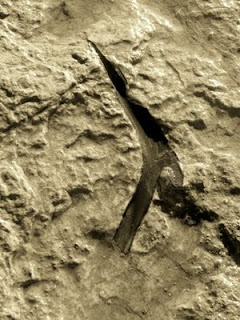
of stones signified something important contained within. The largest held the dilophosaurs that were taken, and which the Navajo were now fighting to get back so they could build their own museum, and an individual that still remained while another protected a single, dark brown claw still buried in the rock.
Reaching the far end of the track Junior turns and asks us if we enjoyed the tour and any ‘donation’ would be appreciated, though most people pay $10. All along I had been waiting for this, having experienced similar but unethical scams in Venice where you are taken to a glassworks and have to pay to be shown the way back to your hotel, so was ready to pay more than the ‘suggested’ price to this fascinating man who gave us a snapshot of an amazing life lived in one of the planets most incredible regions. I heartily recommend this area for a if visit if you find yourself heading to the Grand Canyon or Monument Valley.